
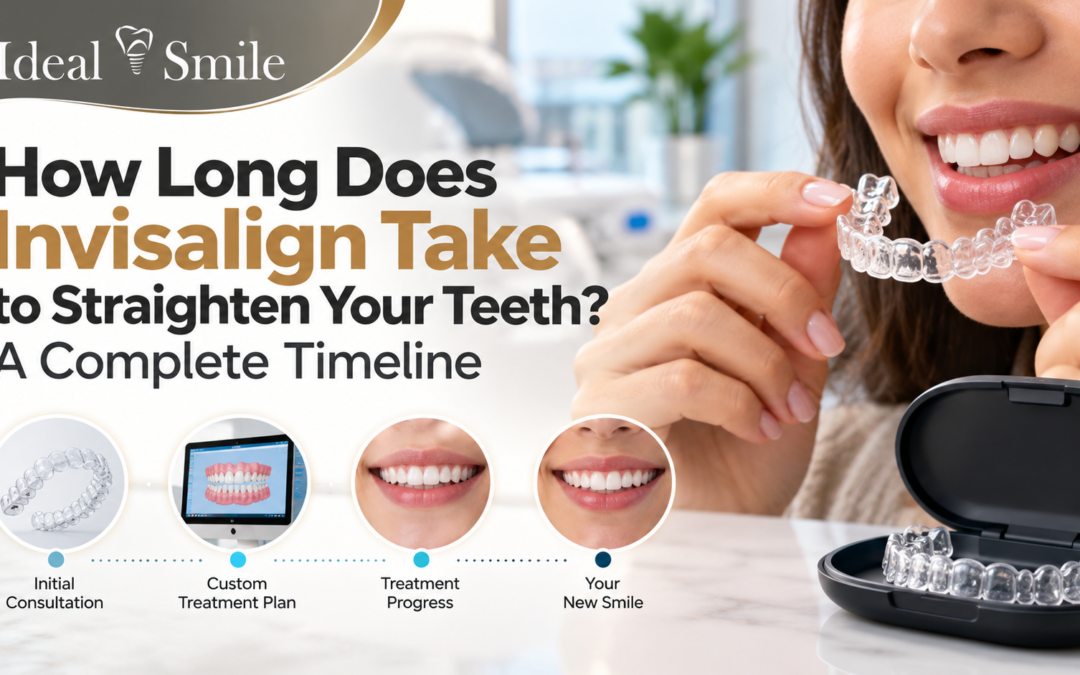
Invisalign treatment typically takes 6–18 months, although the exact timeline depends on your alignment concerns, treatment goals, and consistency with wearing your aligners. Minor spacing or crowding may require only a few months, while more complex bite and alignment issues can take longer.
If you’re considering Invisalign in Bensalem, understanding the treatment timeline can help you set realistic expectations and prepare for each stage of the process.
How Does Invisalign Work?
Invisalign uses a series of customized, clear aligners to gradually move your teeth into their planned positions. Each aligner applies controlled pressure to specific teeth, allowing them to shift gradually over time.
The process generally involves these steps:
- Initial evaluation: Your dentist examines your teeth, bite, and oral health to determine if Invisalign is suitable.
- Digital treatment planning: Digital scans help map your teeth and plan their intended movement.
- Custom aligner creation: A series of aligners is created based on your personalized treatment plan.
- Progressive tooth movement: You wear each set of aligners according to your dentist’s instructions, moving to the next set as directed.
- Progress monitoring: Your dentist checks your progress and determines whether adjustments are necessary.
- Retention: After active treatment, retainers help maintain your new tooth positions.
For most patients, aligners need to be worn around 20–22 hours per day, with removal for meals, drinks other than water, and oral hygiene as instructed.
Consistent wear is essential because the aligners need regular contact with your teeth to guide their movement as planned.
What Is the Average Invisalign Treatment Duration?
The time required to straighten teeth with Invisalign varies based on the type and complexity of the alignment concerns.
| Type of Alignment Concern | General Treatment Estimate |
| Minor spacing or crowding | 3–6 months |
| Mild to moderate alignment issues | 6–12 months |
| Moderate orthodontic concerns | 12–18 months |
| More complex cases | 18 months or longer |
These timelines are general estimates rather than guaranteed treatment durations. Your dentist will evaluate your teeth, bite, and treatment goals to provide a more personalized estimate.
Patients with minor cosmetic alignment concerns may complete treatment relatively quickly. Those who need more extensive tooth movement or bite correction may require a longer treatment period.
During your consultation for Invisalign treatment in Bensalem, discussing your specific concerns can help you understand the expected timeline and what may affect your progress.
What Happens During Each Stage of Invisalign Treatment?
The Invisalign treatment timeline involves several stages, starting with your initial consultation and ending with retainers to maintain your results. Understanding each stage can help you prepare for the process and know what to expect as your teeth gradually move.
Stage 1: Initial Consultation and Evaluation
Your Invisalign journey begins with a dental examination to determine whether clear aligners are suitable for your teeth and bite.
During this appointment, your dentist may:
- Examine your teeth and gums.
- Evaluate your bite and alignment concerns.
- Discuss your smile goals.
- Review your dental history.
- Explain suitable treatment options.
This initial evaluation helps establish your treatment needs and provides an estimated timeline based on the complexity of your case.
Stage 2: Digital Scans and Treatment Planning
If Invisalign is appropriate for you, your dentist may take digital scans or impressions of your teeth. These records help create a customized treatment plan that maps out the intended tooth movements.
During this stage, you can expect to:
- Have digital impressions or scans taken.
- Review your planned tooth movements with your dentist.
- Discuss your estimated treatment duration.
- Have your customized aligners prepared.
The planning stage helps establish the sequence of aligners and the expected progression of your treatment.
Stage 3: Wearing Your First Set of Aligners
Once your aligners are ready, your dentist will explain how to wear, remove, and care for them.
During the first few days, you may notice pressure, tightness, or mild discomfort as your teeth begin adjusting to the aligners. This sensation is generally temporary.
You will also learn how to:
- Wear your aligners for the recommended daily hours.
- Remove them before meals.
- Clean them properly.
- Store them safely when not in use.
- Follow your prescribed aligner-change schedule.
Building these habits early can help you stay consistent throughout your Invisalign treatment.
Stage 4: Progressing Through Aligner Sets
As treatment continues, you will move through a series of aligners that guide your teeth toward their planned positions.
Your dentist in Bensalem will provide instructions about when to switch to each new set. Depending on your treatment plan, aligners may be changed every one to two weeks.
Progress appointments allow your dentist to check:
- How well your teeth are moving
- Whether the aligners fit properly
- Whether your treatment is progressing as expected
- Whether any adjustments are necessary
Consistent aligner wear and regular progress checks help keep your treatment on schedule.
Stage 5: Final Adjustments and Retainers
Once your teeth reach their planned positions, your dentist will assess the results and determine whether any additional refinements are needed.
Some patients may require extra aligners to improve specific tooth positions or make final adjustments. After active treatment is complete, your dentist will recommend retainers to help prevent your teeth from shifting.
The retention phase is an important part of maintaining your results and protecting the time invested in your Invisalign journey.
When Will You Start Seeing Invisalign Results?
Some patients notice subtle changes in their teeth within the first few weeks of Invisalign clear braces treatment. However, visible progress varies depending on the starting position of your teeth and the movements planned for your case.
Several factors influence how quickly changes become noticeable:
- Alignment concerns: Minor spacing or crowding may show visible changes sooner than complex bite issues.
- Treatment goals: The type and extent of tooth movement affect how progress appears.
- Consistent wear: Following your dentist’s instructions helps your aligners work as planned.
- Individual response: Tooth movement differs from person to person.
Avoid judging your progress based on daily visual checks alone. Your dentist can assess changes during follow-up visits and use progress photographs when appropriate.
Patience and consistency are important throughout treatment. Even when changes seem gradual, your clear aligners may be making steady progress toward your planned results.
5 Factors That Affect Invisalign Treatment Time
The time it takes to straighten your teeth with Invisalign depends on several factors. Your initial alignment, daily habits, and response to treatment can all influence your Invisalign treatment timeline.
1. The Complexity of Your Alignment Issues
The condition of your teeth and bite has a significant impact on treatment duration. Minor spacing or crowding may require relatively simple tooth movements, while more complex orthodontic concerns can take longer to address.
For example:
- Minor crowding: Slightly overlapping teeth may require a shorter treatment period.
- Gaps between teeth: Closing small spaces may take less time than correcting multiple alignment issues.
- Bite problems: Certain overbites, underbites, or crossbites may require more extensive treatment.
- Complex tooth movements: Significant rotations or movements involving multiple teeth may extend treatment.
Your Bensalem dentist will evaluate these factors before estimating how long Invisalign takes in your specific case.
2. How Consistently You Wear Your Aligners
Invisalign relies on consistent wear to guide teeth through planned movements. Most patients are instructed to wear their aligners for approximately 20–22 hours per day. Frequently removing your aligners or forgetting to put them back in can interrupt the process and delay progress.
To stay consistent:
- Follow your dentist’s daily wear instructions.
- Remove aligners only when necessary.
- Put them back in promptly after meals and oral hygiene.
- Use reminders if you often forget to wear them.
- Keep your aligner case accessible when eating outside your home.
Consistent wear helps your teeth follow the planned movement schedule and reduces the likelihood of unnecessary delays.
3. Your Age and Individual Dental Factors
Invisalign brace aligners can be an option for both teens and adults. However, age alone does not determine how quickly treatment will work. Your individual dental characteristics, oral health, and the type of tooth movement required all influence the treatment duration.
Factors your dentist may consider include:
- Current tooth alignment
- Gum and bone health
- Previous orthodontic treatment
- Bite characteristics
- Overall dental condition
Adults considering Invisalign for adults can achieve meaningful alignment improvements. Their treatment timelines depend on their specific orthodontic needs rather than age alone.
4. Your Response to Tooth Movement
Every person’s teeth respond differently to orthodontic forces. Even when two patients have similar alignment concerns, their treatment timelines may differ. Your dentist monitors how your teeth respond to the aligners and checks whether they are moving as planned.
If tooth movement progresses more slowly than expected, your dentist may adjust the treatment plan or recommend additional monitoring.
Regular progress checks help identify concerns early and determine the next steps.
5. Additional Aligners or Refinements
Some patients need refinement aligners toward the end of treatment. These additional aligners help address tooth positions that have not reached their intended alignment during the initial series.
Refinements may be recommended when:
- Certain teeth have not moved as planned.
- Small gaps remain.
- Additional bite adjustments are needed.
- Final alignment improvements are necessary.
Needing refinements does not automatically mean your treatment has gone wrong. Tooth movement can vary, and additional adjustments may be part of achieving your planned results.
However, refinement aligners can extend your overall Invisalign treatment duration, depending on the number of additional movements required.
What Can Delay Invisalign Treatment?
Several everyday situations and treatment-related factors can affect your progress. Common causes of delays include:
- Inconsistent aligner wear: Wearing aligners for fewer hours than recommended can slow tooth movement.
- Lost or damaged aligners: Replacing an aligner or determining how to proceed may affect your schedule.
- Missed appointments: Skipping progress checks can delay necessary adjustments.
- Poor aligner fit: Aligners that do not fit as expected may need professional evaluation.
- Additional refinements: Extra aligners may be required to complete planned movements.
- Dental problems: Cavities, gum concerns, or other oral health issues may require attention during treatment.
If your aligners stop fitting properly or you experience an unexpected issue, contact your dentist instead of changing your treatment schedule on your own.
How to Stay on Track With Invisalign Treatment
Following your dentist’s instructions and maintaining consistent habits can help you complete Invisalign treatment according to your planned timeline. While you cannot control every aspect of tooth movement, you can take practical steps to avoid unnecessary delays.
Here are six ways to support steady progress:
- Wear aligners as instructed: Aim for the daily wear time recommended by your dentist.
- Follow your aligner-change schedule: Switch to your next set only when directed.
- Clean and store aligners properly: Keep them clean and protect them from damage when removed.
- Attend scheduled appointments: Regular checkups allow your dentist to monitor tooth movement and address concerns.
- Report fit issues promptly: Contact your dentist if your aligners feel unusually loose, do not fit properly, or become damaged.
- Maintain good oral hygiene: Brush and floss regularly to support healthy teeth and gums throughout treatment.
Consistent habits can help prevent avoidable setbacks and make your Invisalign experience more manageable.
Invisalign vs. Traditional Braces: Which Takes Longer?
Both Invisalign and traditional braces can straighten teeth, but the treatment duration varies based on the complexity of your orthodontic needs.
| Feature | Invisalign | Traditional Braces |
| Treatment duration | Varies by case, often around 6–18 months | Varies by case, often around 1–3 years |
| Mild alignment concerns | May be completed in a shorter period | May also be treated relatively quickly |
| Complex orthodontic concerns | May require longer treatment or may not be suitable for certain cases | Can address a broad range of complex cases |
| Patient responsibility | Requires consistent aligner wear | Remains fixed throughout treatment |
| Progress monitoring | Regular checks and aligner adjustments | Regular checks and wire or bracket adjustments |
| Eating and cleaning | Aligners are removed for meals and oral hygiene | Requires cleaning around brackets and avoiding certain foods |
Neither option is automatically faster. Your treatment timeline depends on the tooth movements required, your oral health, and how your orthodontic care is managed.
A consultation can help you compare both options and understand which approach fits your dental needs.
When Should You Consider Invisalign in Bensalem?
If you have crooked, crowded, or gapped teeth, Invisalign may be an option worth exploring. Clear aligners can help address several common alignment concerns while offering a removable and discreet alternative to traditional braces.
You may want to schedule a consultation if:
- Your teeth have shifted over time.
- You have gaps or overlapping teeth.
- You want a less noticeable orthodontic option.
- You experienced shifting after previous braces.
- You want to understand your treatment options before making a decision.
Patients exploring Invisalign treatment in Bensalem can benefit from a professional evaluation that considers their current alignment, bite, oral health, and smile goals.
Start Your Invisalign Journey With a Personalized Treatment Plan
The time needed to straighten your teeth with Invisalign depends on your alignment concerns, treatment goals, and consistency with wearing your aligners. Understanding these factors can help you prepare for treatment and set realistic expectations.
At Create Ideal Smile, patients considering Invisalign in Bensalem can discuss their smile goals and receive guidance about their treatment options. A personalized evaluation can help establish an estimated timeline and explain what to expect at each stage.
Schedule your Invisalign consultation at Create Ideal Smile and take the first step toward a straighter smile.
Frequently Asked Questions About Invisalign Treatment Time
1. How long does Invisalign take to straighten teeth on average?
Invisalign treatment often takes around 6–18 months. However, minor alignment issues may take only a few months, while more complex cases can require longer treatment.
2. Can Invisalign straighten teeth in 3 months?
Some patients with very minor alignment concerns may qualify for shorter treatment plans that last around three months. However, this depends on the movements required and your dentist’s assessment.
3. How long does Invisalign take for mild crowding?
Mild crowding may be corrected in approximately 3–6 months in some cases. Your actual treatment duration depends on the amount of tooth movement required and your response to treatment.
4. When will I start seeing results from Invisalign?
Some patients notice subtle changes within the first few weeks. Visible progress varies depending on the starting position of the teeth, treatment goals, and consistency with aligner wear.
5. Can Invisalign treatment take 2 years?
Yes. More complex alignment or bite concerns, additional refinements, or interruptions in treatment can extend the timeline to two years or longer.
6. Does wearing Invisalign for fewer hours delay treatment?
Yes. Wearing aligners for fewer hours than recommended can interfere with planned tooth movement and potentially extend your treatment duration.
7. How often do I need to change my Invisalign aligners?
Many treatment plans involve changing aligners every one to two weeks. Your dentist will provide a schedule based on your specific treatment plan.
8. Do refinements make Invisalign treatment longer?
Refinements may extend treatment because they involve additional aligners and tooth movements. The extra time depends on how much adjustment is needed.
9. Is Invisalign faster than traditional braces?
Invisalign may be faster for certain mild or moderate alignment concerns, but traditional braces can be more suitable for some complex cases. The treatment duration depends on individual orthodontic needs.
10. How can I make my Invisalign treatment go faster?
You cannot safely force your teeth to move faster than your treatment plan allows. Following your dentist’s instructions, wearing aligners consistently, attending appointments, and reporting problems promptly can help you avoid unnecessary delays.